Showing posts with label laboratory. Show all posts

Friday, 16 June 2017

Four: Animation and a New Laboratory


I've been working to improve the animations for my project. Feedback has it that where the most improvement is needed in when Four runs or walks. However one of the larger complications has been that in order to smooth out the way hands moved about, the control around the wrist was re-parented so that it moves with the base and not the torso.

This has the added advantage that she can more easily grasp things, and the hand stays in position better when Four is stationary, but it does mean that all the hand positions need readjusting.


  One update that might have slipped is an improvement to the scale of the rooms. Everything was a little large and off-scale so one of the challenges has been to compress a few things so the environment feels less cavernous. This may have a knock on effect in that Four would need to be smaller. Part of what I learned while researching for the project is that grubs can be much larger than the insect they grow into, likely because the fat and material they store up is also what keeps them alive during the energy-intensive metamorphosis project. It might be a simple case of not making the size differences as drastic but at the same time, Four isn't a low-level predator, and animals whose shoulders may reach the waist when on all fours can stretch taller than an adult human when they try standing on their hind legs.


Thursday, 1 June 2017

Lab Toys


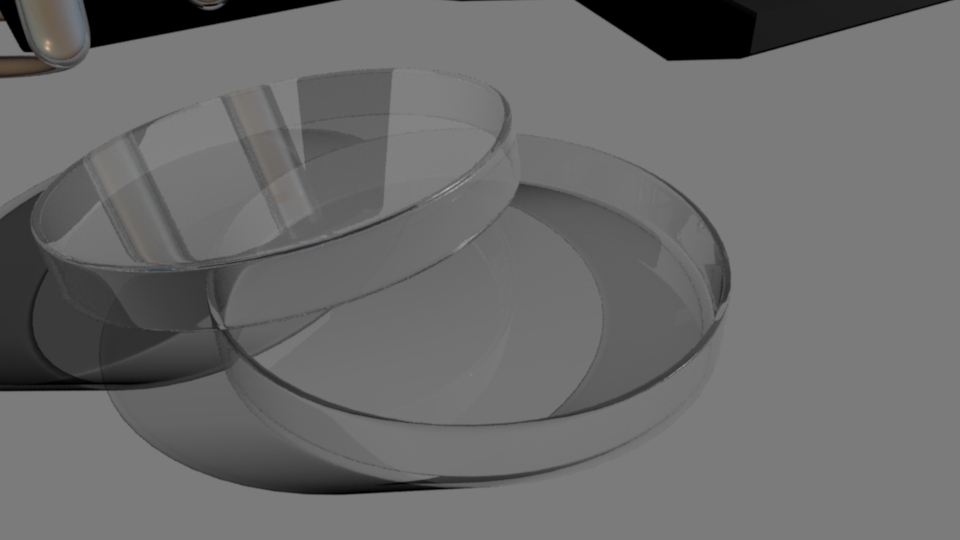
Playing about with some techniques to represent glass mostly, but after a pause, things are moving along.


For the prop department, one of the things needed was some lab equipment, so to work my way back int oa routine I started simple: Test tubes, petri dishes, pipettes, tube racks and finally a microscope (though while the base is finished, the model still needs some serious shader work). Other device considerations planned but yet to be designed include a crucible and some scales, which will be scattered about the workspace.


It was exciting designing these as I was reminded of science classes back in school, an interest in science has been part of the inspiration for Four overall so it was good fun designing some of the equipment that I've conducted experiments with..


Wednesday, 26 April 2017

Four: Adjusting Cameras, the Grub is Live


  For the past couple of days I have primarily been working on creating animations for the creature to move about the world. 


  More significantly, the camera's focal length has been changed to provide a more natural look. Looking back and forth the previous camera angle felt a little wide, exaggerating the distance between the foreground and the background which made the rooms look enormous. So far it is only the sequences before and with the grub and with the adult form that the camera angle has been adjusted. The camera angles for the juvenile form will need to be updated and that is on my list.


Most of the camera angles have remained the same save for the distance the camera is from the subject, save for one or two minor changes to improve flow and keep interest. Some of the angles had to be re-tilted as they pointed towards the floor but the improvement does feel significant.


Wednesday, 15 February 2017

Four: Lighting the Biolab


  As well as completing the incubation chamber today, I thought I might play around with lighting.


  The biology branch of the lab will have several incubators. In the middle will be tables for scientific apparatus, clutter and research notes.


  I find that using a spotlight (below) provides a more dramatic light than using an area light (above) as the light created is much more confined. The spots on the roof see ma little off.


  What the spotlight appears to produce well however is a light from the isolation unit. Creating a stark shadow of the unit's doors. The light inside is confined by being made unable to pass through the glass, the light created from the door is being produced by a more specifically-aimed spotlight to preserve the strength of the light. I may need a third light however to illuminate the rest of the room. This trick can be used in other areas where the light may be different ,such as the adjacent office or the corridor - two shafts of light projecting themselves on the wall opposite the windows looking out into the darker corridor.


The new arrangement of the lab is going to mean some changes to the movement of the camera as it navigates the room. With proper lights in the room I can experiment with how to portray the glass.


  Some time in the past few days was also taken to sketching some posing research, how Four might move as she walks, runs, and a few minute movements that would sell the character..

Thursday, 9 February 2017

Four: David's Desk Part One


  With some of the larger models out of the way, I had the thought that while the camera needs installing, some smaller models could be made, mainly for things I feel sure would be seen in the world. David's desk will take some focus at the very least so at least I have some assets to experiment with when setting up cameras.


  This was all after designing the finer details on David's computer terminal. To give some authenticity when in a close-up view, I took to modelling the keyboard key-by-key and arranging the UVs to correspond with their arrangement on the board.This sort of arrangement will make it easier when creating the texture maps for the keys. Once complete I designed a low-resolution "cover" that would display the keys' definition as a normal map and maybe extrapolate the textures so at a distance the solid block looks like a convincing keyboard. Drawing from how I designed Four's mouth,  an indentation was created to provide for an area for the keys to be set into, The edge can be just-about seen so it does not look like the keys are simply phasing into the surface of the computer's keyboard extension.


  The size of the computer terminal necessitated the need for for more space on the desk. Geometry was pushed forward slightly and the UV maps were re-adjusted accordingly to square out the stretching.


There might be some way to go, and before I get into science equipment like microscopes, centrifuges, test tubes etc. I have some experience with college-level genetic science, experiments included, I have some understanding already of the kind of equipment that might be practical for microbiological research (Alfonse's field of study in the story) and DNA sequencing. Although a combination of camera-work and estimates on what to focus will determine just equipment to keep, as some devices and equipment I understand might not be recognised by a general audience.

Wednesday, 8 February 2017

Four: More Biolab Furniture


  Work continues on the lab, enough that I can provide some rudimentary render/colour tests. Most elements have simple blinns and lamberts with an ambient occlusion ode, while the metal was given a basic chrome shader to make it look more properly metallic.


I felt my initial table designs were not the kind of science fiction atmosphere I was aiming for.


A first design I had was a more trestle-table look, but reflecting back this was the wrong kind of structure for the table I was aiming for so instead I looked into the design feature of metal tubing. I could either have built a frame that planted the table firmly on the ground although the desks that did this offered a gap for the seated's legs and chair.

  The alternative possibility was a more cafeteria bench, where the pipe-like legs went down and then curled up to support benches. This wasn't really practical, like the desks the seated's legs have full freedom and the pipe that supports their seats rise up to go under the seating. So I tried something inspired by the cafeteria bench.


  More UV maps, after looking at references the computer is more convincing. Though I may have to settle for a fully modeled keyboard at close-to-near-mid distance and a mock box at more distant ranges.


Tuesday, 7 February 2017

Four: Furnishing the Biolab


  With the corridor models done I've gone back to the biolab to build David's office and the corresponding articles starting with the largest furniture - the chairs and tables.


  As can be seen by the figure behind the chair, I needed a scale, which in hindsight I perhaps should have made first. It's only basic but it serves the neccesity of providing a means to brig in a more human scale for construction as this is an ultimately human environment. The biolab needed furniture that conformed to human ergonomics. For the furniture I went back to my references of 1970s designs


  So far the components I can call complete aside from UVs are a desk, an office chair, and a stool. While close to completion, the computer terminal in David's office (an attempt at designing a terminal with the elegant sleek side of the 60s while understanding that CRT screens were what people thought would always be used for monitors) needs a keyboard. Looking at my influences (the source of the CRT screen, all-in-one look and integrated keyboard area), maybe the computer is better off with more of a back to it as right now it more closely resembles a flatscreen pretending to be a CRT.


One of the elements of Four's isolation unit that I drew up in concept art was a bed that mostly resembled some kind of bean-bag. With some geometry tweaks, the moulded seats of the stools might work as a foundation for the bed's model.


Monday, 6 February 2017

Four: Corridor Semi-Completion


  The key components for the tunnels around Ceti base are ready for textures and lights. The essential elements assembled are a blast door, a tunnel, a straight intersection, and a T intersection. I might be able to build the focus corridor with these. Although creating an X-intersection will only take me an hour or two to build, it is more a question of whether such a section can be mimicked with camera-work and the T-section..


Because of the number of models involved I am thinking of creating a system where at a far enough distance, the leather panels and the pipes along the bottom are replaced with panels that mimic their look. The same would be the case for the flourescent lights in order to save complexity during renders.


  I feel I can sign these models off for now, and will come back to these for textures, normals and so on at a later date.


  The models are kept symmetrical by mirroring. I create one quarter of the section and then mirror the geometry, then I mirror the UV maps and sew contiguous sections together so that just because the geometry is mirrored does not mean what's on the surfaces has to be. This is also the case with putting UV shells on top of each other. I'm moving away from this to experiment with more varied appearances.


For easy importing and instancing, each segment has been given its own scene file under a special asset folder..

Wednesday, 2 November 2016

Major Project: Biolab Framework


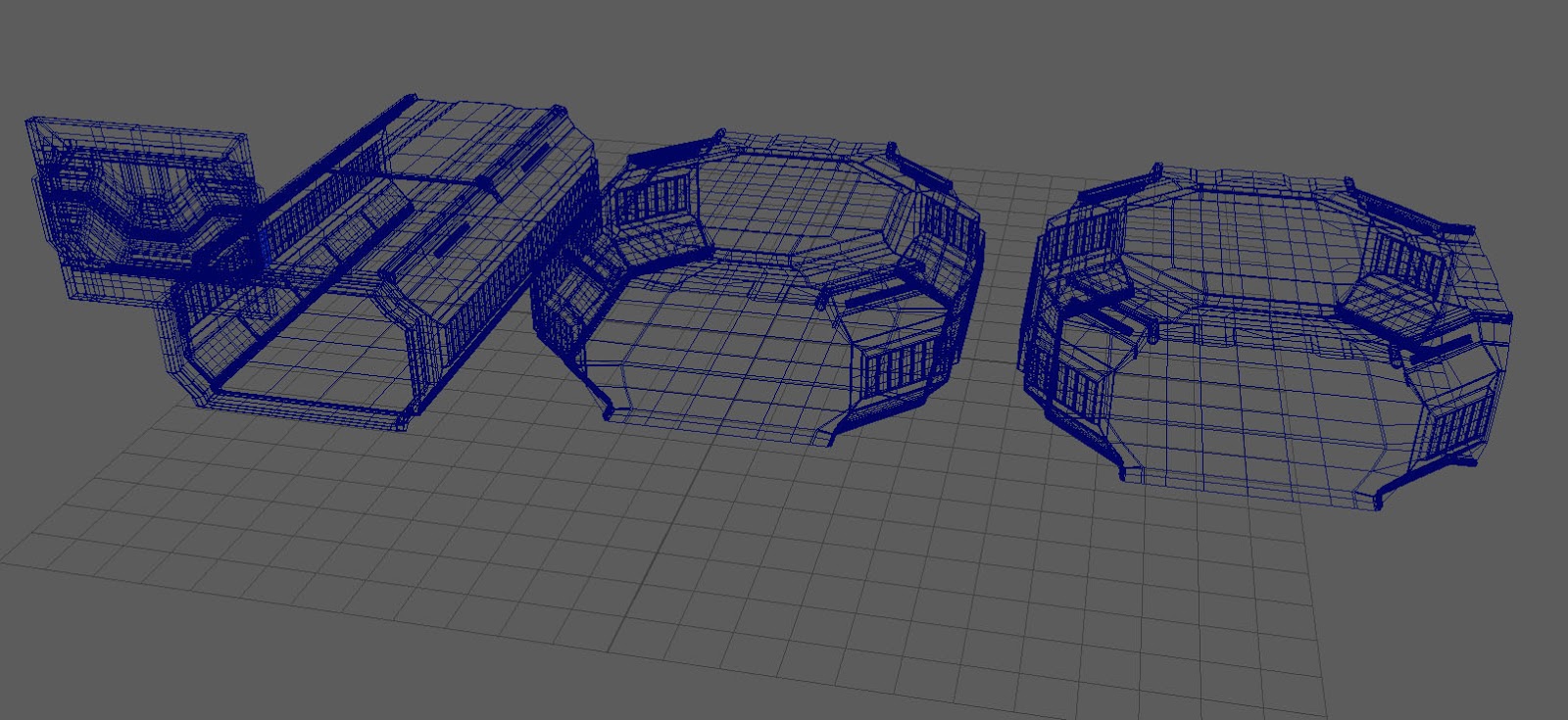
  To keep things efficient I decided to aim for creating a framework of each of the three key locations. Working out the design I think is also helping to unify the design aspects, as in my concept drawings these walls were flat and blank. After work on the office, I was inclined to add features from the office into the biolab such as concave walls, and the doorframes


  Creating the cubicle doors poses an additional challenge that I look forward to. At the end of the story, Four bolts out of open doors, so these doorways will need ot be designed to look like the door isn't simply phasing though a wall when it opens. These technicalities are more for the final model but at this stage the consideration could be space. Or in the case of the isolation units, indicators for a frame for the doors to slip into.


  At the moment I'm happy the current design is fairly close to the thumbnails. I'm quite enjoying modeling these rooms which I think is a positive to take away. But that also means I shouldn't get carried away. So my current mental goal is to block out the furniture, maybe frame a few doors, add some blockout shaders to all surfaces and then call the biolab done and ready for a camera.