Showing posts with label science fiction. Show all posts

Sunday, 19 May 2019

Four Redux - Biolab Walls Redesign Progress


  Coming back to my old work and upgrading it has so far been an enjoyable exercise in design techniques. Transforms, textures, warpings and UVs, all sorts of tricks have been used to give a serious touch-up on what I have previously built.


  The most engaging stage so far has been trying to keep the look authentic while also making a distinct style. The laboratory run by Smithston-Wessex, the megacorp funding an expedition to a far-off planet, is clean, slick, but this hides the more insidious nature of their work. While it might be a little safe to design a sterile look for one of my major forays into environment modelling, the uncomplicated nature allows me to focus on clean design. Which, with that mastered, can be a springboard for more daring aesthetics.


  I have brought the environment forward in time a little. Looking back on my references, I was always inspired by the styles of the late 1960s and mid 1970s. Too contemporary for the original Star Trek, a lot more in line with Space 1999 and 2001: A Space Odyssey

  The new design however might have creeping elements of Star Trek: The Next Generation, which developed its style in part from the visual re-imagining given to the original Star Trek series for its films. What I mainly took from this series was maybe the cleaner, rounded styles (which was popular in the Sixties) but definitely the large bands of fluorescent lighting. Along the ceiling and stretching from bottom to top, this design choice is really good for giving an illuminated feel to a room. A little impractical if you're actually within the room as it basically has you staring into a fluorescent light wherever you look, but definitely a feature emblematic of the era's science fiction film and television.


  I did not want to go overboard with the creep towards the 80s. Although it is going to be interesting to combine this with the Ridley Scott-esque corridors of the base since I made a few subtle changes to the shape of the doorways and window openings. Not that I'm too worried, I considered redesigning the doors anyway.


  True to form, I'm not done yet with this style - apart from the obvious bits like the need for a ceiling and a floor, I want to remake the doors to the isolation chambers (as well as the isolation chambers themselves) in that tapered peak threshold but in a way that is far more in line with the aesthetic I am going for. What I have in mind is to adapt the panelling already used for the door and window to fit the door to the isolation unit, which might need more bulk as it is supposed to be more heavy-duty than your typical base door.

  Could be adapting what I have, could be I design new geometry for it. But it will be enjoyable.


  For now I have decided to focus on the biolab itself. In a sense, it is my "hero" environment, where most of the project takes place. The corridor, which in previous efforts was designed as if it were a focus, will come later as it can be attached to the windows looking out into the rest of the base.

Mock environments, locked doors and reflected, polarised or shuttered windows could be used to make the base appear much larger than it really is.


  And just as a demonstration of the difference, here is the biolab design in the first attempt, with a few props, a door and a window to give an idea just how much of an overhaul this has been. To say it has been significant however I believe is an enormous understatement.


Personally I can hardly tell these are intended to be for the same room.

Sunday, 11 November 2018

Media Reviews: Demons of the Punjab

Forward: It has been honestly years since I last posted something on this site. I want to thank everyone who has been curious despite the inactivity, and with some recent vigor this might change. Time to bring back something that was once a ritual for me with a review.

  For most of my life I've always found science fiction to be one of the most magical of genres. From the medieval space adventures of Star Wars to the FTL-less explorations of space of Leviathan Wakes. Hard or soft, plausible or magical, whether Star Trek has been a wagon train to the stars or Stargate with more space ships, science fiction has had a rather unique position in the cultural sphere.

This is what particularly hit me with tonight's Doctor Who episode Demons of the Punjab.

  First off, I can already imagine some might see political commentary in this episode. I've kind of had my head in American politics for a while and I can see the episode's mention of "angry men on the radio" speaking of something seen in divides on both sides of the Atlantic Ocean. This is something the latest season of Doctor Who has been doing though I personally though find this is one of the strongest series to date. Despite the messages laid within we've had some a very compelling and emotionally gripping stories.

It goes without saying, if you have not seen the episode then I'm going to be dropping a few spoilers.

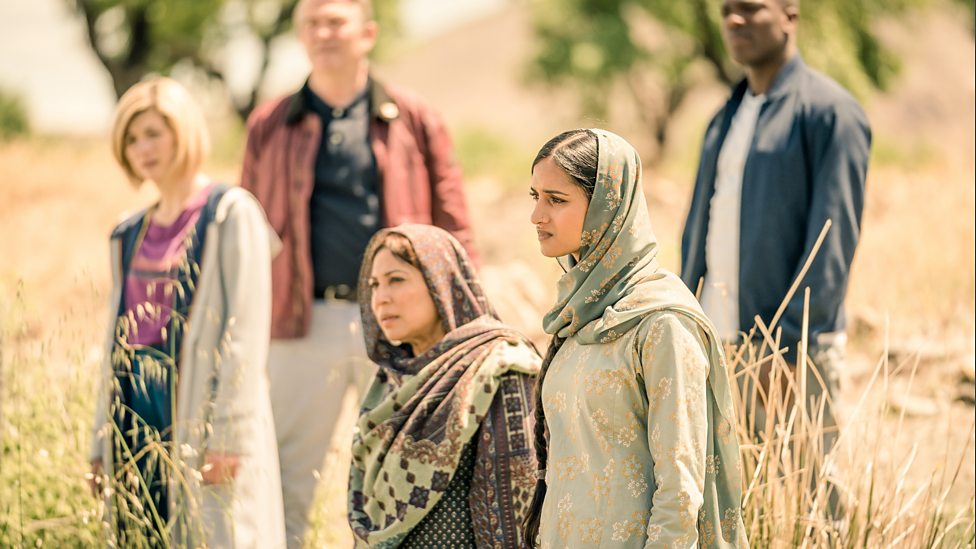
Sample 1: So far the series has been in plenty of remote locations. But this has its advantages. [BBC, 2018]

  This episode is set in Lahore as the Partition of India gets underway. It's 1947. The separation of Pakistan from India after tension between Hindus and Muslims reaches a boiling point. The British Empire is waning, only just starting to recover from the Second World War while memories of famine remain fresh on local minds. But a lot of these tectonic shifts are largely in the background for the episode - the partition is explored by the Doctor's Pakistani-British companion Yaz discovering her grandmother's husband was a Hindu, and the division this creates with her grandfather's younger brother, a staunch Indian patriot. About halfway through the episode, it is brought up that this younger brother has his head deep in the revolutionary words spoken over the radio. He doesn't say any creative slurs (which has been all too easy in modern political discourse), but he does make it clear his vision for his country does not include his Muslim neighbors. Not only that, but while angry radio voices are mentioned, it isn't argued if these voices are right or wrong in what they say.

Fear and anger can spur people to do terrible things. As we find out.

  Science Fiction, for me, is at its best when its story is three things: Mindful of the past, thinking of the future, and observant of the present. Some of my favourite stories in science fiction use the past or the future to hold a mirror up to the present. The Partition of India was not pleasant, there was a lot of unrest with the establishment of these two nations. Lives were lost, blood was shed along the new border, but Demons of the Punjab never shows this. Not even at the climax when history's course reveals itself do we see a life lost on screen. The unrest is invisible yet its effects are a driving force of the plot. When we discover it was not the visiting aliens who killed a local holy man, but a man who believes he is doing what is right. Two thirds of the way through, the demons in the title are implied to not be the visiting aliens, but human beings who would make their neighbors to be monsters to build their vision of a brighter future.

  Having grown up in a household with rich thoughts on the wars, what comes to mind for me when Yaz's grandfather tries to talk sense into his brother are accounts in the Great War where soldiers of both sides came to realise the enemy weren't so different from themselves. This is something at the forefront of my mind, especially as on this particular celebration as the London ceremony was graced by the president of Germany. At the ground level, whatever your leanings be they spiritual, social or otherwise, the ones who think or sit differently likely have the same problems you do. Others may disagree with your ideas, but that does not make them something to remove.

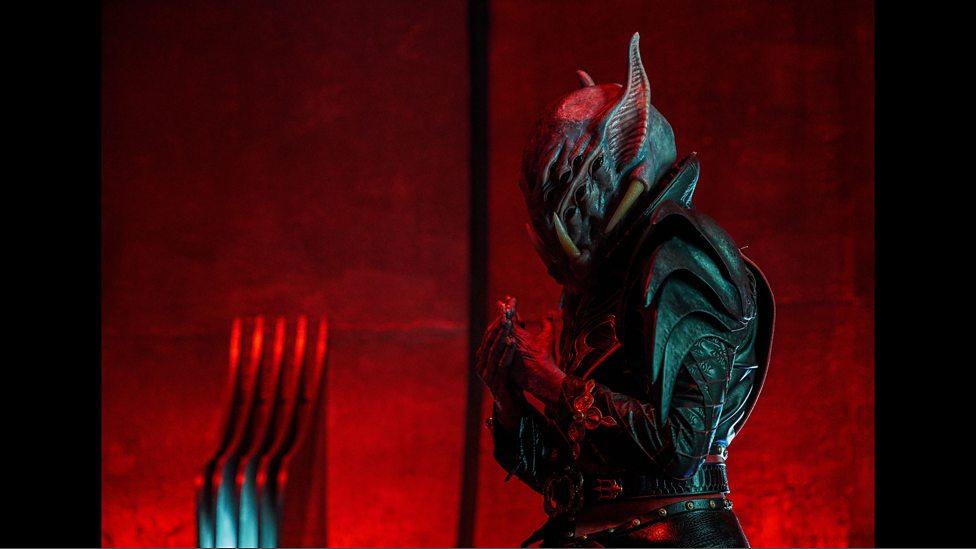
  The story is not all about political division and the atrocities which can be committed in the name of a righteous vision. At first it seems like the "demons" of the episode are the aliens. Which the Doctor describes as an ancient race who have molded themselves into the perfect assassins (which makes them peers of the Weeping Angels and the Carrionites). Turns out these assassins reformed after finding themselves on the verge of extinction. what is left now wander time and space collecting imprints of people who have died alone. They didn't come because Earth was special or that they had an interest in someone important. Yet they were very civil once their true nature was revealed, which just goes to show that a dreaded reputation does not mean you are dealing with heartless monsters. On the day the participating nations of two devastating wars take time to remember the fallen, it warms the heart to see a group who would trek across space and time to do the same for everyone who has ever lived or shall live. Not just soldiers or those in service, but everyone who departs out of reach of those who care about them.

Sample 2: Not all which is alien are monsters. Not all monsters are alien. [BBC, 2018]

  The eleventh of November is a time to remember those who gave their lives to protect their homes and their families. Risking everything but getting caught up in the maelstrom of war. The catalyst was a war to end all wars that ended nothing. The soldiers who fought in it do not choose who to fight, and the ones they are set up to oppose are probably no different from they are when you strip away ideology or higher-level principles.

Demons of the Punjab held a mirror to what we're doing to ourselves right now, but it was also a welcoming tribute to those who gave their lives to protect those they cared about or those who helped the unfortunate, who in their final moments had no one beside them. Offering a light that maybe we are not alone in this remembrance. However your Sunday has been, remember this as a day of remembrance of all the fallen for all the nations.

Image Sources


Monday, 19 March 2018

Personal: Heart of an Empire


  I've wanted to get back into creating with Maya now that I am in a more confident place at home. It was a surprising lesson these past couple of months how your environment can influence your motivation. Bygones are bygones now, and I want to get back into my A-game. 


  I've been tweaking and polishing this planet today, making the city lights appear more convincing and giving substance to the ring around it (a discussion session online suggested to me their old distance might risk exposing visitors and occupants to highly lethal levels of radiation. I suppose high-tech science fiction shielding could protect them, and there was even a suggestion the ring-builders could have found a way to clear the radiation belts, but that distance was also impractical for ferrying freight and commerce, which benefits from a low-hanging belt. Shorter transit distances and all that.


  I thought about adding more than one ring because the engineers would not be limited to one orbital structure, and could hang more off the first (maybe even, fur, five, or ten!) And even this massive ring might have its limits for a civilisation connected to millions of other planets. So like any ground project, the infrastructure could have been expanded in times past to meet increasing demand.

 If I ever get this animated, it could be fun to surround the planet with dancing particles that represent hundreds to thousands of incoming and outgoing starships. Watching The Expanse lately I've been enamored with the introduction sequence, particularly the streaks of light that represent 100 years of interplanetary shipping and the timelapses showing urban growth and the great projects undergone in the series' backstory.


   I believe the Expanse has been one of my major influences regarding this project. Studying satellite photographs of the Earth at night helped a lot in building a convincing night-time illumination.A place can be as much a character as a person or an object, it's all about knowing how to convey that story without words.

Wednesday, 14 February 2018

Mosquito Redesign: Working Legs


  I didn't have much success implementing an IK nor getting it to compress, but they say the simplest solution is often the most effective. In the case of my piston the simple solution was to parent each of the pistons with each other, tie them to 'aim' themselves at the opposing hinge and create a few driven keys to mimic the pistons extending and compressing.


  After that it was a simple matter of constraining each of the hinges. and the pistons so they stop at a fixed instance into and out of their sockets. By adding a fifth segment to the leg I am able to extend its reach to a motion window of between 92 and 168 degrees (any more open and the piston will collide with the knee hinge). Which might be one of them ore complicated elements of the model out of the way.


From what has been assembled so far, I think I can easily fit six of the legs into the main body with plenty of room to spare.


Tuesday, 13 February 2018

Mosquito Redesign: Leg Hydraulics and Industrial Fun


  Much of this afternoon has been spent reworking the leg to make it something more industrial. I've looked into completely redesigning the limb using the hydraulic system idea to give the legs weight and balance. What I've got so far appears to work to a decent degree, even if the geometry might be a little heavy. I'll look into fixing the UVs before the leg is repeated.

  The piston that would appear to keep the leg unbent will use some manner of spline to adjust itself. I'll need to perform some experiments to get a system that can extend the segments - what is on display is the furthest the leg can bend with this but with some clever re-positioning I might be able to extend the leg further. I can also use the freedoms presented by the digital medium to make it easier for the base to compress into the pivot it's connected to, allowing the sections to fold in and extend automatically and the pivots to rotate appropriately. This further tweaking might also allow the lower leg to more easily fold in.


  That still leaves how to fit six of these inside the body. The folding in isn't the most efficient use of space, it could be the legs are arranged diagonally and drop through hatches in the mosquito's underside (which will be fun to build and set up). Only one leg will be worked on until the UVs, bones and controls are set up, which will be reproduced five times.


  Overall, it appears to be quite a flexible setup. The leg bends in the right place, the lower joint provides most of the positional mobility and the foot has full free rotation so it can plant itself flat in a large variety of poses. An IK/FK system could be used for deployment, positioning and resting as one thing that could be implemented are shock-absorbers at the ankle - a simple tube that compresses into the body to give the feeling the machine is bearing weight when its turns its engines off.


It's about ready for the UVs

Saturday, 10 February 2018

Mosquito Redesign: Early Stages and Legs


  I'be been thinking for a couple of days now about going back and redesigning one of my old projects. Namely the mosquito craft from one of my first year university projects. This design was ambitious, even back then and the video it came with was somewhat popular so I thought why not go back and rebuild the thing with better creative knowledge, problem solving skills etc.?


   One thing I really wanted to try out in the old design was some form of foot. In the original model I believe they were just spikes due to time pressures. With a better grasp of Maya's rigging and component system I feel confident I can do a proper foot as well as better joints. For fun I could design all kinds of bells and whistles: Brake flaps, redesigned landing gear bays, ailerons, a probe bay, maybe even rotary blades in the wings and a segmented design to allow for full-wing tilting and proper VTOL.


   I've mostly been inspired by the ship designs made by Cloud Imperium for Star Citizen. I tried the game out once during a free weekend and was amazed at all the little animated components the one-man ships had whether it was for doors, maintenance hatches, thrusters, airlocks, you'd think they brought in mechanical engineers to work out all the components. I might not go that far, the mosquito in the sequence primarily concerns landing and takeoff but no lie, it would be fun to try and build some sort of open folding mechanism for the front probe or the landing gear.


   I might keep the hydraulic system. It was quite useful for compacting the legs into the body (all six of them) and this time around I could go an extra step, maybe include the tubes for the hydraulic fluid that could be linked to the model via a spline curve.


  I am definitely going to need some kind of control rig to sort out all the moving parts I already have. It would definitely make accessing the components for animation a lot easier, too.


Saturday, 19 August 2017

Planet Modeling: Refining Night-Time Lights


  Along with some other plans I returned to my planet. I'd say it is roundabout complete as much of the time was spent on Wednesday polishing the night map. Looking at the planet with the various layers such as mountains and rivers (which from space would be intensely lit up rather than these dark patches they were before).

  Climate, temperature and elevation might also affect where cities are built, and while I could not quite work out how to turn the illumination off when exposed to a directional light, the daytime illumination doesn't appear too glaring.


Although for them ore intense areas there may be some question as to why the valleys around various riverbanks are practically golden.


Wednesday, 19 July 2017

Building Planets


Today I had some fun with some rather literal worldbuilding. Using the free visualisation Space Engine offers an immense variety and some very powerful procedural generation software. Seeing the rendering power of this engine I decided to experiment with Maya, taking some of its possibilities further, as although effective with natural phenomena, I wondered about using it as a springboard for some science fiction models.

After extracting the procedural generation of a particular planet into bump and diffuse maps, I took them into Maya and built a model out of three spheres - the base planet, a cloud layer, and a faux atmosphere with a transparency determined by its facing ratio to the camera.


Space Engine tended to crash when exporting a Mercator projection larger than 4096 x 2048 pixels, but offered a box projection option as an alternative where it would export a file into six smaller images. A box projection allowed for the construction of a more high-definition model and could be useful for close-up shots.

The world I used was rather dead, so using Mudbox I painted on bands of colour that would mimic foliage.


The night map - intended to show signs of civiliseation - was the most bespoke part of the project,.as Space Engine has no way of building this on its own. It had to be created from scratch and was used as an illumination map.


The techniques used to build the shaders and the textures could - with further practice - be built more from scratch, allowing for more custom-designed planets that can be built in the span of an afternoon.

Sunday, 9 July 2017

New Designers: Final Submission

Year 3 Major Project: Four from Mark Stamp on Vimeo.

A bereaved scientist finds love again far from home, but as he comes to connect with this new lease of life the company's plans must force him to let go.

Sunday, 2 July 2017

Four: New Designers Approaching


New Designers is but a few days away, but this blog has been quiet so to alleviate that I present a few stills that I have prepared.


  Rendered in full HD quality, and what I have has been tested in a video sequence. Getting everything right and keeping everything clean well however has been nothing short of a monolithic task. This project started a long way, back, as far back as September and to see the outcome now feels exhilarating as the home stretch presents itself.


I also took some time to build a business card. Nothing too flashy, gets the job done rather nicely though.


Tuesday, 20 June 2017

Four: An Adult With Polish

  With progress done om the environment model I went back to the animation sequences. With the time that I have available I feel I can definitely push out some much cleaner and more lifelike animations. Currently building a library along the way. It won't translate easily into the juvenile - who has a very different style of movement - but the groundwork should speed up the pace.

 A rather diligent cutting of the animation down to four minutes has been a struggle, as there is always that question of what to keep and what to remove. But after some thorough examination, and the sacrificing of a few details here and there which in a number of cases could be supplemented by visual information, the video flows a little more succinctly and fits within that alotted time frame.


Friday, 16 June 2017

Four: Animation and a New Laboratory


I've been working to improve the animations for my project. Feedback has it that where the most improvement is needed in when Four runs or walks. However one of the larger complications has been that in order to smooth out the way hands moved about, the control around the wrist was re-parented so that it moves with the base and not the torso.

This has the added advantage that she can more easily grasp things, and the hand stays in position better when Four is stationary, but it does mean that all the hand positions need readjusting.


  One update that might have slipped is an improvement to the scale of the rooms. Everything was a little large and off-scale so one of the challenges has been to compress a few things so the environment feels less cavernous. This may have a knock on effect in that Four would need to be smaller. Part of what I learned while researching for the project is that grubs can be much larger than the insect they grow into, likely because the fat and material they store up is also what keeps them alive during the energy-intensive metamorphosis project. It might be a simple case of not making the size differences as drastic but at the same time, Four isn't a low-level predator, and animals whose shoulders may reach the waist when on all fours can stretch taller than an adult human when they try standing on their hind legs.


Friday, 9 June 2017

Four: More Prop Progress


  I've spent the last week building a number of props that will be scattered about the laboratory. While they add to render times, they are necessary components to sell the world.


  Also to sell the world are some features to dial back some of the sterility of the locations. Interest elements like pipes and a new feature to the ceiling were installed to make the place feel less eascetic. One of the intentions for a final pass is a layer of dirt and grime, partially achieved by the ambient occlusion from the pipes and tables but more still needs to be added to make the whole thing convincing.


  Also to sell the world: Some experimentation with photogrammetry and more general texture maps to sell a convincing texture for the world being built. This experimentation has so far been interesting, I was surprised at some of the difference it makes to making an object convincing.