Showing posts with label base. Show all posts

Friday, 16 June 2017

Four: Animation and a New Laboratory


I've been working to improve the animations for my project. Feedback has it that where the most improvement is needed in when Four runs or walks. However one of the larger complications has been that in order to smooth out the way hands moved about, the control around the wrist was re-parented so that it moves with the base and not the torso.

This has the added advantage that she can more easily grasp things, and the hand stays in position better when Four is stationary, but it does mean that all the hand positions need readjusting.


  One update that might have slipped is an improvement to the scale of the rooms. Everything was a little large and off-scale so one of the challenges has been to compress a few things so the environment feels less cavernous. This may have a knock on effect in that Four would need to be smaller. Part of what I learned while researching for the project is that grubs can be much larger than the insect they grow into, likely because the fat and material they store up is also what keeps them alive during the energy-intensive metamorphosis project. It might be a simple case of not making the size differences as drastic but at the same time, Four isn't a low-level predator, and animals whose shoulders may reach the waist when on all fours can stretch taller than an adult human when they try standing on their hind legs.


Thursday, 1 June 2017

Lab Toys


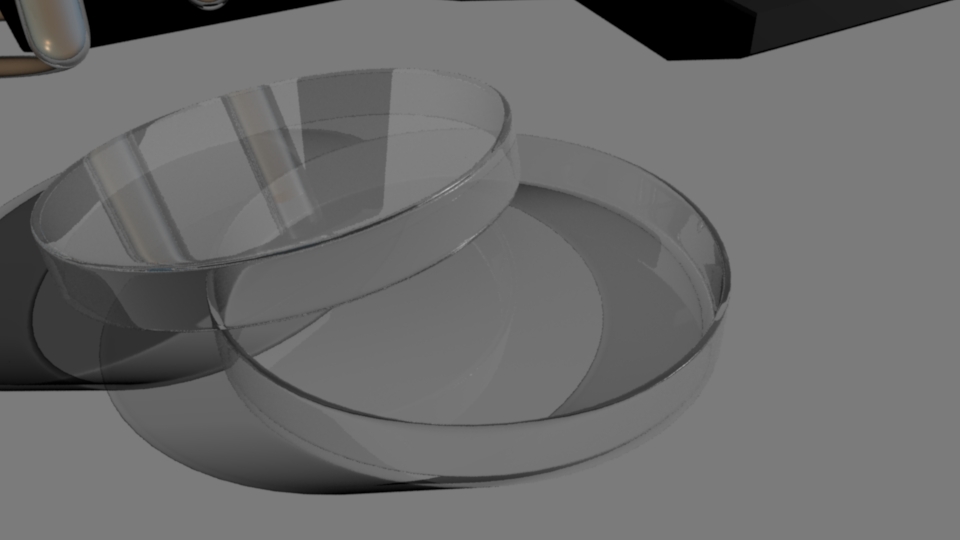
Playing about with some techniques to represent glass mostly, but after a pause, things are moving along.


For the prop department, one of the things needed was some lab equipment, so to work my way back int oa routine I started simple: Test tubes, petri dishes, pipettes, tube racks and finally a microscope (though while the base is finished, the model still needs some serious shader work). Other device considerations planned but yet to be designed include a crucible and some scales, which will be scattered about the workspace.


It was exciting designing these as I was reminded of science classes back in school, an interest in science has been part of the inspiration for Four overall so it was good fun designing some of the equipment that I've conducted experiments with..


Friday, 5 May 2017

Four: Lighting Continues


  Lighting setup for the main room is almost done. I plan to transfer the setups that have been created  (as well as a few of the assets that needed their UVs improving) to the other scene files in order to save time as the rooms do not change that much.


  To save on materials, some texture files were combined using a layered texture plugin that with some alteration to the UV layouts allow for multiple models to use one material easily, saving on using repeat materials and repeat colours. Getting a better handle on the surface shader also made its installation much handier, and the effect I can get out of it feels much more natural.


  Like with other assets, the lights will need to be grouped with the model, so that when the scale of the model changes, they change to remain in place. What I'll still need to keep in mind is how much will the various lights change as they are re-positioned and re-scaled. A final outcome is close, just a little more time and attention needed and I should be ready to start on final compositions.


Thursday, 4 May 2017

Four: Corridor Lighting


  Much of yesterday was spent on animating some of the final scenes, which means that to an extent, act 3 (where we see the adult) has a functional set of animations.

  So today's priority was lighting. This however turned into more work than I initially anticipated as in order to shave off render times I considered looking where I could optimise my scene. Presently my shaders were monochromatic - I would create a single shader for a specific colour, but this proved inflexible and I ended up building up a number of shaders with the same settings just different shades.


  I was able to replace some of the shaders using maps created in Photoshop, which I am considering fleshing out with textures to make the materials feel more like real materials and less like plastic. While other materials use a blinn, the white panels use a mila shader textured to come across more as leather, using similar properties to Four's skin due to leather's properties.


A warmer grey for the bulk material of the corridor appears to work more with the aesthetic I am aiming for. Aside from a number of hot-spots, the lighting in place (area lights positioned opposite each other) works to fill out the scene.


Strangely the frame above took considerably longer to render than the corridors, Four's teeth also appear to be reflecting the light of the surface shader used to represent the sunlight. I could disable it for when the camera switches to this shot as the effect is almost obliterating the sight of her teeth.

Wednesday, 15 March 2017

Four: Presenting Play and A New Adult


Written into the script, one idea was for Four to knock over the phone as Amelia is talking. This scene should be more interesting than Four simply wandering into David's office and giving the camera puppy-eyes.

Anyone with a pet cat knows they love playing with inanimate objects by giving them pokes, jabs and pushes to see what they do or how they fall over. As a creature of predatory heritage, Four might have similar instincts so this might be entirely in-character for her.


Preparing for the third act I went back to the adult model. While installing the spine to simplify control over Four, a slight problem came out in that when installing a curve to a spine, the joints will contract to fit the CV curve, which would make reattaching the blendshapes problematic. The solution so far (which has given freedom in correcting the skeleton) has been to essentially fix the skeleton then rebind the skin and paint the weights back on. 


As I had done this before a couple of times now I might be able to re-paint the skin weights fairly promptly. That is the plan, as the deadline of mid-May is coming and I have to reserve a week or two for export to a render farm and post-processing.

Monday, 6 March 2017

Four: A Return to Work and Development


Returning from a hiatus refreshed and ready to continue, I'm moving along with the essentials of the project. UV maps have been cleaned up and most importantly for the model, the walls and floor have been separated from each other.


  Together they felt too much like one combined structure, separating it out made it easier to define where they met. After a discussion that it might be inappropriate for Four to be raised in the same room as plants were studied, I set up a system that would effectively 'switch' between a plant lab and an animal biolab. To control the switch, a control was added over the room, in later stages this might be used to switch between the stages of progression. Multiple states would exist on one spot that can be set using this control.


  Separating out the walls, ceiling and floor also allowed me to develop cleaner geometries for these large surfaces. Much of the more dense geometry was due to the edges used to hold the geometry around windows and doorways in place. With these more separate, the layouts for the floors and ceilings could breathe more.


With the rooms set up and the distinctions made, I also set about reworking the camera to make better use of the new layout and serve as a foundation for what objects to place and where, and where in the lab might be seen. At present, only David's first recording and Amelia's first message have been matched to a camera but I'm sure more will quickly come over the coming week or so.

Wednesday, 15 February 2017

Four: Lighting the Biolab


  As well as completing the incubation chamber today, I thought I might play around with lighting.


  The biology branch of the lab will have several incubators. In the middle will be tables for scientific apparatus, clutter and research notes.


  I find that using a spotlight (below) provides a more dramatic light than using an area light (above) as the light created is much more confined. The spots on the roof see ma little off.


  What the spotlight appears to produce well however is a light from the isolation unit. Creating a stark shadow of the unit's doors. The light inside is confined by being made unable to pass through the glass, the light created from the door is being produced by a more specifically-aimed spotlight to preserve the strength of the light. I may need a third light however to illuminate the rest of the room. This trick can be used in other areas where the light may be different ,such as the adjacent office or the corridor - two shafts of light projecting themselves on the wall opposite the windows looking out into the darker corridor.


The new arrangement of the lab is going to mean some changes to the movement of the camera as it navigates the room. With proper lights in the room I can experiment with how to portray the glass.


  Some time in the past few days was also taken to sketching some posing research, how Four might move as she walks, runs, and a few minute movements that would sell the character..

Tuesday, 14 February 2017

Four: Biolab Incubation Unit


  After some thought it was considered that for the plant and grub stages, an incubator was more appropriate for housing the creature than an isolation unit.(shown near the back). The subject can be observed from all angles and a layer of soil will provide the ideal environment to nurture Four in her mossy life-state while also studying her. The screens on the incubator can be used to convey information for scientists and the viewer.


  Today's session also gave me some practice with adding glass. Refraction was considered but first attempts resulted in more reflection. Later tests could refine the mechanic as these are set up primarily as two planes that fit into the grooves all the window models have.


  To demonstrate that Four is one of a number of experiments, the lab will contain several chambers. This will make it easier to view hers from the office and can show the company has several experiments going at a time, The rearrangement of features could also suggest relocation to different labs. A laboratory for nurturing plants or grubs might have different requirements compared to a lab designed to handle animals .


I had fun designing the LEDs and the knobs for controlling settings on the incubators. There is an air that part of the design could include clutter, though 1960s-period science fiction tended to be a lot cleaner, with pipes and wires being hidden. SOme variance in the LEDs could be given - blues, yellows and whites that would flash to give colour variance.

Thursday, 9 February 2017

Four: David's Desk Part One


  With some of the larger models out of the way, I had the thought that while the camera needs installing, some smaller models could be made, mainly for things I feel sure would be seen in the world. David's desk will take some focus at the very least so at least I have some assets to experiment with when setting up cameras.


  This was all after designing the finer details on David's computer terminal. To give some authenticity when in a close-up view, I took to modelling the keyboard key-by-key and arranging the UVs to correspond with their arrangement on the board.This sort of arrangement will make it easier when creating the texture maps for the keys. Once complete I designed a low-resolution "cover" that would display the keys' definition as a normal map and maybe extrapolate the textures so at a distance the solid block looks like a convincing keyboard. Drawing from how I designed Four's mouth,  an indentation was created to provide for an area for the keys to be set into, The edge can be just-about seen so it does not look like the keys are simply phasing into the surface of the computer's keyboard extension.


  The size of the computer terminal necessitated the need for for more space on the desk. Geometry was pushed forward slightly and the UV maps were re-adjusted accordingly to square out the stretching.


There might be some way to go, and before I get into science equipment like microscopes, centrifuges, test tubes etc. I have some experience with college-level genetic science, experiments included, I have some understanding already of the kind of equipment that might be practical for microbiological research (Alfonse's field of study in the story) and DNA sequencing. Although a combination of camera-work and estimates on what to focus will determine just equipment to keep, as some devices and equipment I understand might not be recognised by a general audience.

Wednesday, 8 February 2017

Four: More Biolab Furniture


  Work continues on the lab, enough that I can provide some rudimentary render/colour tests. Most elements have simple blinns and lamberts with an ambient occlusion ode, while the metal was given a basic chrome shader to make it look more properly metallic.


I felt my initial table designs were not the kind of science fiction atmosphere I was aiming for.


A first design I had was a more trestle-table look, but reflecting back this was the wrong kind of structure for the table I was aiming for so instead I looked into the design feature of metal tubing. I could either have built a frame that planted the table firmly on the ground although the desks that did this offered a gap for the seated's legs and chair.

  The alternative possibility was a more cafeteria bench, where the pipe-like legs went down and then curled up to support benches. This wasn't really practical, like the desks the seated's legs have full freedom and the pipe that supports their seats rise up to go under the seating. So I tried something inspired by the cafeteria bench.


  More UV maps, after looking at references the computer is more convincing. Though I may have to settle for a fully modeled keyboard at close-to-near-mid distance and a mock box at more distant ranges.